

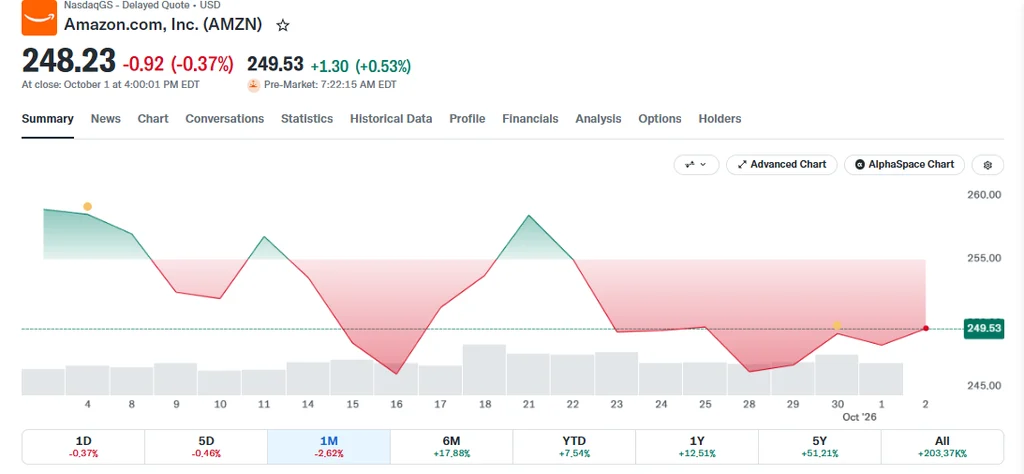
A $1,000 stake in Amazon placed a decade ago would be valued at approximately $6,083 today, representing an increase of roughly 508%. Moving from a split-adjusted $40.81 to $248.23 at the October 1, 2026 close, the entirety of this 10-year gain stems purely from share price appreciation, given that Amazon has never distributed a dividend. However, the performance of AMZN stock appears considerably less striking for those who entered more recently, demonstrating that returns heavily rely on entry timing.
Also Read: Amazon Stock: Could AWS and AI Push Shares to $350 in 2027?
Amazon Stock Return, AMZN Performance And The $1,000 Investment
From Online Store To AI Landlord
Investors who allocated $1,000 to Amazon shares in 2016 were backing a vastly different enterprise. Annual revenue climbed from $107 billion in 2015 to $716.9 billion in 2025, while operating income expanded from $2.2 billion to $79.98 billion.
During the second quarter of 2026, AWS generated $42.2 billion in revenue—a 36.7% increase—achieving an operating margin of 39% and accounting for about 60% of Amazon’s total operating profit. CEO Andy Jassy, who succeeded Jeff Bezos in 2021, projects that AWS could eventually reach $1 trillion in annual revenue.
How Timing Changed The Amazon Stock Return
The following breakdown illustrates how a $1,000 commitment to Amazon shares fares across three distinct holding periods, utilizing entry figures monitored by 24/7 Wall St. alongside the most recent closing price:
- 1-Year: bought at $218.15, up 13.79%, now about $1,138
- 5-Year: bought at $171.28, up 44.93%, now about $1,449
- 10-Year: bought at $40.81, up 508.26%, now about $6,083
The 10-year return stands in a completely different tier. An investor who held the $1,000 position for a decade is up roughly $5,083 in absolute terms, compared to an increase of about $138 for a one-year investor. Furthermore, five-year purchasers navigated through 2022, a turbulent period for AMZN stock performance during which Amazon posted a $2.7 billion net loss. At the time of writing, the 52-week trading band spans from $196 to $287.16.
Zero Dividends, A $220 Billion Plan And What Analysts Expect
A $1,000 investment in Amazon has distributed precisely $0 in cash payouts over the years, meaning all gains derive entirely from price shifts. Capital expenditures reached $53.1 billion in the second quarter, pushing trailing free cash flow down to -$7.6 billion.
Jassy noted:
“We now believe we will spend approximately $220 billion in cash CapEx in 2026.”
He also cautioned that free cash flow will remain under pressure until newly constructed data centers become operational. For retirees seeking regular income, the sole method to extract cash from an Amazon position is to liquidate shares at prevailing market rates. Conversely, growth-focused investors leave all funds deployed, allowing the overall return to compound.
Huge Investment in US Communities
This infrastructure expansion carries a local footprint as well. On October 2, AWS announced plans to dedicate over $1 billion across five years to American communities situated near its data facilities, targeting initiatives such as workforce training, energy affordability, and water conservation. Amazon channeled $276 billion into data centers between 2011 and 2025, while more than 100 data center moratoriums are currently under evaluation nationwide.
AWS CEO Matt Garman stated:
“There is urgency to this data center buildout because we aren’t the only country that sees the benefits of AI for the economy and national security, and the countries that lead in AI will shape it and get the most from it.”
Also Read: Amazon Stock Can Fall 10%, Reach a Low of $230: Rothschild Prediction
Wall Street maintains a largely optimistic outlook on upcoming AMZN stock performance, boasting 15 strong buy designations and 44 buy ratings. The consensus analyst price target sits at $329.54—roughly 33% higher than the current share price—which would elevate a new $1,000 allocation to about $1,328 if realized. Replicating the historical 10-year return from present levels would push the stock price to approximately $1,510. For anyone contemplating a $1,000 Amazon investment today, the potential for upside exists alongside market volatility, all without any baseline dividend income.