

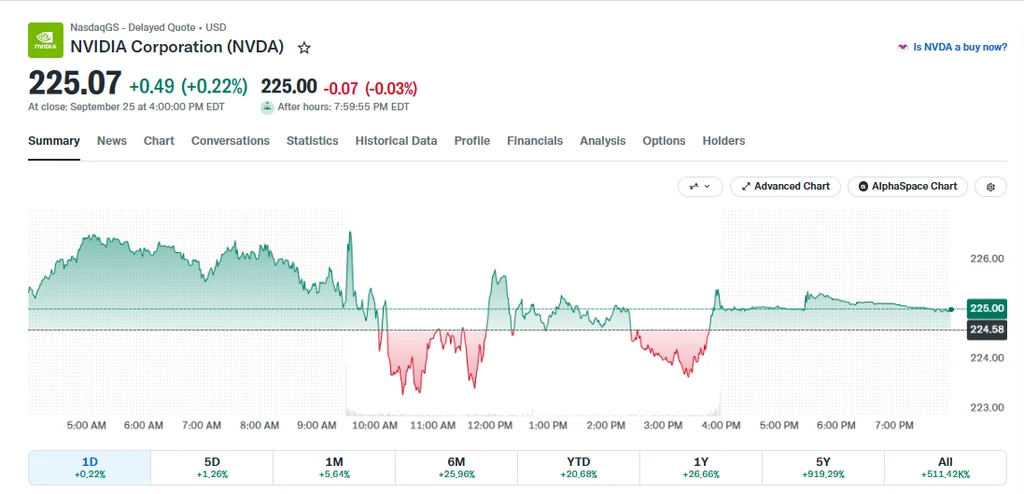
While predicting an exact date for a downturn in Nvidia stock is impossible since share prices fluctuate alongside real-time economic data and market forces, traders can monitor specific triggers. These include decelerating AI growth, major clients manufacturing proprietary chips, supply shortages, trade restrictions, and widespread market sell-offs. Following the September 25 close, NVDA stood at $225.07. Wall Street maintains a bullish outlook for Nvidia, sustaining an average price target of $328.66. Nevertheless, tangible risks have kept the 2026 rally relatively restrained so far.
When Will Nvidia Stock Go Down? Risks, Forecast And Price Targets
Even with continued business expansion—highlighted by second-quarter fiscal 2027 revenue reaching $96.2 billion, representing a 106% year-over-year increase—the question of when NVDA might decline remains prominent.
Nvidia CEO Jensen Huang stated in the Q2 fiscal 2027 earnings release:
“AI has reached its inflection point. It’s doing useful work.”
However, the share price has not completely matched this pace, posting a modest year-to-date gain of about 18% in 2026 amid lingering market anxieties regarding an AI bubble. Consequently, future direction depends less on quarterly earnings and more on external factors surrounding the firm.
Supply Limits And Customers Building Their Own Chips
Although difficult to time, supply constraints represent a subtle risk for NVDA shares. Leadership projected approximately 70% growth for fiscal 2028, conditioning that figure on manufacturing availability, with CFO Colette Kress identifying memory scarcity as the primary constraint.
Jensen Huang addressed this on the August 26 earnings call:
“Our demand is much greater than 70%.”
Over the long term, a more substantial threat stems from major buyers like Amazon, Google, and Meta engineering their own processors in-house. A drop in the stock price on this front would likely materialize once these key purchasers significantly reduce their reliance on Nvidia graphics processing units.
Taiwan, Export Rules And Market Shocks
Because TSMC manufactures Nvidia’s cutting-edge processors with a heavy operational concentration in Taiwan, any disruption in the region could severely impact the share price. International chip sales are likewise constrained by trade policies and export regulations. Furthermore, NVDA exhibits notable volatility, boasting an annualized volatility rate of roughly 41.9%. During a broader market sell-off, the stock would likely retreat swiftly—exemplifying risks that remain entirely outside corporate control.
What Analysts Expect From The NVDA Stock Price Target
Current forecasts for Nvidia lean firmly positive. Among 61 analysts surveyed by S&P Global, the consensus rating stands at a Strong Buy. The average price target of $328.66 sits roughly 46% higher than current trading levels, while the lowest target of $180 illustrates the potential downside should AI investments falter. Only the most pessimistic Wall Street analyst anticipates a slide to that particular price point.
Regarding expenditures on artificial intelligence, Jensen Huang offered this perspective:
“The AI infrastructure buildout is at full steam.”
Also Read: Nvidia vs. SpaceX: Which AI Stock Has More Potential?
Ultimately, disappointing financial results do not appear to be the catalyst that would push Nvidia stock downward based on prevailing projections. Instead, the 2026 outlook hinges much more heavily on supply constraints, proprietary customer hardware, geopolitical shocks in Taiwan, or a widespread market correction.